| 17cm SK L/40 Cartridge Casing |
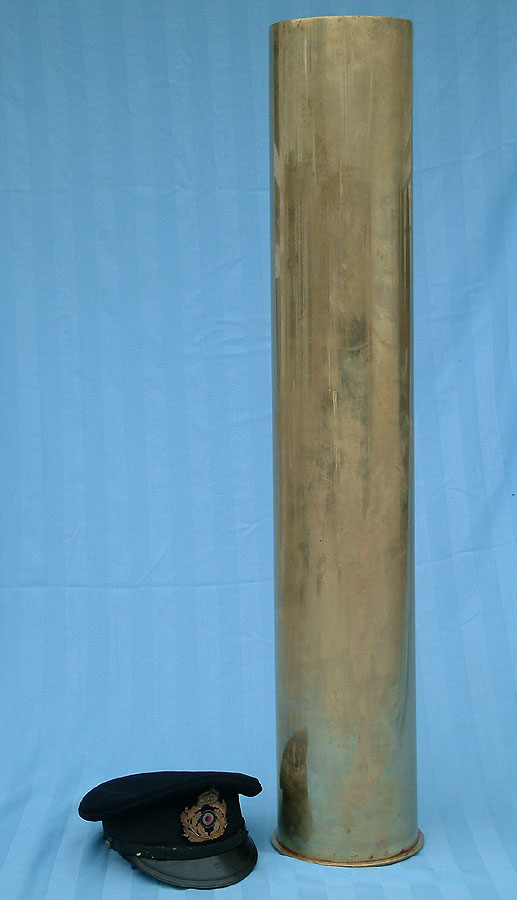
17cm cartridge casing for the Krupp SK L/40 Kanone.
The 17cm SK L/40 (SK: Schnelladekanone = quick loading cannon) were Krupp naval cannons that served as secondary armament for the Kaiserliche-Marine (Imperial German Navy) pre-dreadnoughts in the Braunschweig and Deutschland classes.
After the loss of SMS Pommern on 01 June 1916 at the Battle of Jutland, the four surviving Deutschland class battleships were removed from the line, allowing their reserve 17cm SK L/40 cannons to be released to the Army resulting in the 17cm SK L/40 i.R. (i.R.: in Räderlafette = on Wheeled carriage) and the 17cm SK L/40 Samuel Eisenbahngeschütze (Railway Gun).
To illustrate the size, the casing is photographed with an original period Kaiserliche-Marine officer's Schirmmütze.
17cm SK L/40 Cartridge Casing Data:
- Height - 1052mm (41.45 inches)
- Actual Calibre - 176mm (6.92 inches)
- Base Diameter - 204mm (8.03 inches)
- Weight - 14.1 kg (31 lbs.)
- Manufacturer - Patronenfabrik Karlsruhe
- Date - August 1906
|
 |
|
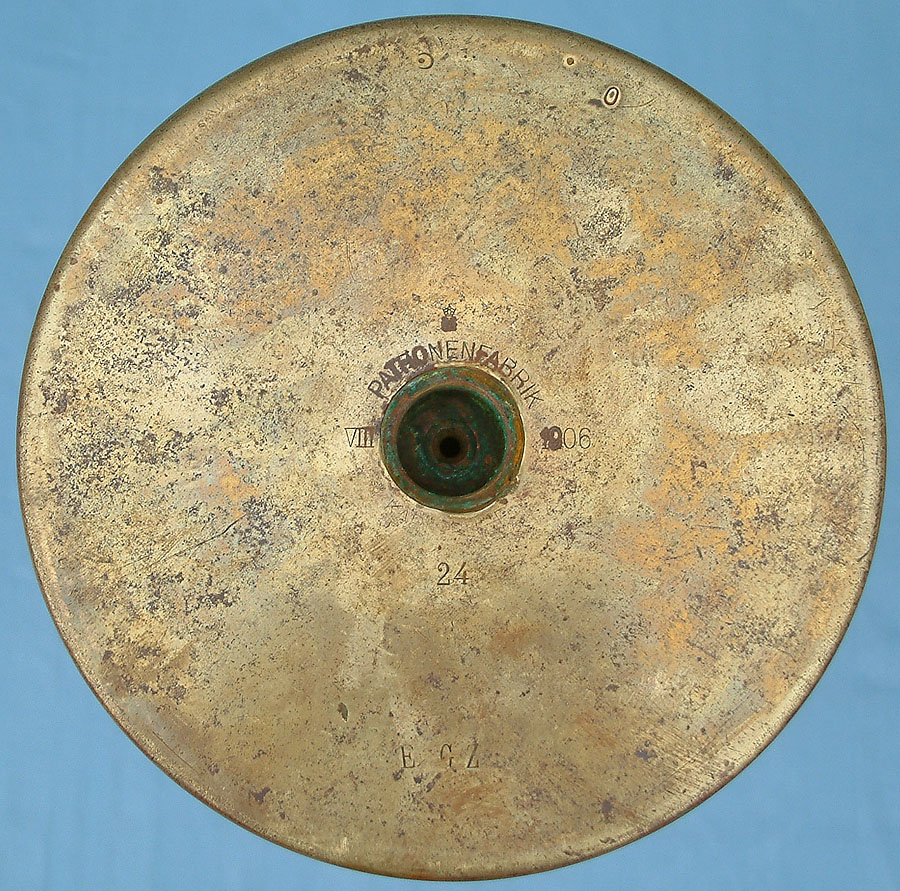 |
| A close-up of the head stamping on the base. Marked: PATRONENFABRIK (cartridge factory) KARLSRUHE manufactured "VIII 1906". Marine cartridge casings used Roman numerals for the month, while the Army used an abbreviation of the month. The "VIII" in this case stands for August. The crowned M is the Kaiserliche Marine (Imperial German Navy) arsenal's acceptance stamp. "24" is the lot number of that batch of cases which were made during 1906. The dots on the top indicate that the casing was reloaded twice. Unfortunately the primer is missing. |
| |
| |
| 17cm SK L/40 |
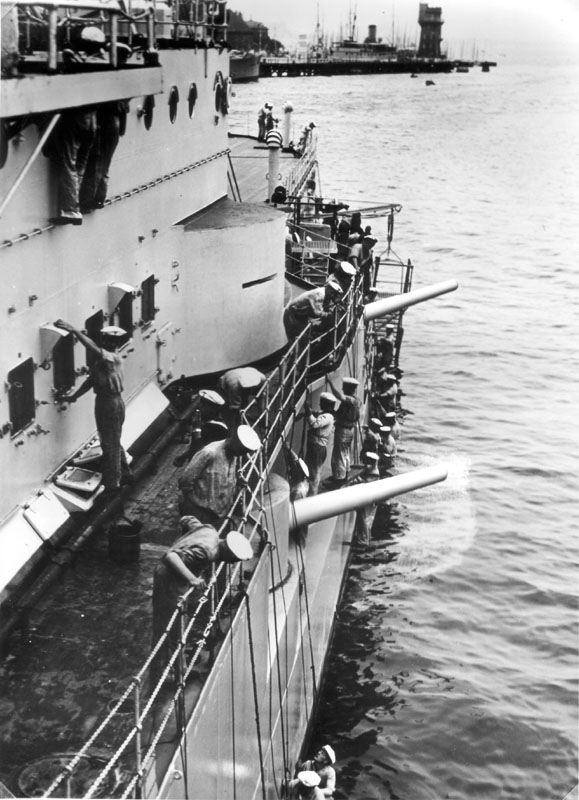
The 17cm SK L/40 were Krupp naval cannons that served as secondary armament for the Kaiserliche-Marine (Imperial German Navy) pre-dreadnoughts in the Braunschweig and Deutschland classes. The Deutschland class carried 7 per side for a total of 14 which were housed in Kasematten (casemates).
The 17cm SK L/40 almost seem out-of-scale when looking at them in period photographs, as what appears to be a small round turret, is actually a shield around a relatively large 17cm cannon with a 6.80 meters (22 feet 4 inches) barrel. This is why when looking at photos, if the gun is all the way over in any direction, a gap often appears on the far side of the Kasematten, which is the end of the shield.
17cm SK L/40 Cannon Data:
- Weight - 10.7 metric tons (11.79 tons)
- Range - 17.0 km (10.56 miles)
- Manufacturer - Krupp
- Barrel Length - 6.80 meters (22 feet 4 inches)
- Projectile - 64 kg (141.0 lbs) Armour Piercing High Explosive projectile
|
 |
|
| 17cm SK L/40 i.R |
 |
17cm SK L/40 i.R. (i.R.: in Räderlafette = on Wheeled carriage) was the result of mating 17cm L/40 Marine cannons from the Braunschweig and Deutschland classes with a wheeled carriage to produce the Krupp 17cm Feldkanone i.R. (i.R.: in Räderlafette = on Wheeled carriage). For field use, the cannon was placed on a special ground platform (visible in the photo above) which allowed traverse in azimuth. The naval cradle was mounted to the carriage and then the carriage was anchored to the special firing platform. The 17cm SK L/40 i.R was the heaviest Marine cannon to be put on a wheeled carriage which required it to be broken down into three loads that could then be moved by tractor.
The photo above shows a 17cm Feldkanone i.R. at the magic moment; being fired. Typical for many cannons over 10cm, it utilized semi-fixed ammunition where after the projectile was rammed home, the brass cartridge casing containing a set amount of propellant and the primer was inserted. The two Kanonier (Gunners) that are not covering their ears, must already be deaf. |
| 17cm SK L/40 Samuel Eisenbahngeschütze (Railway Gun) |
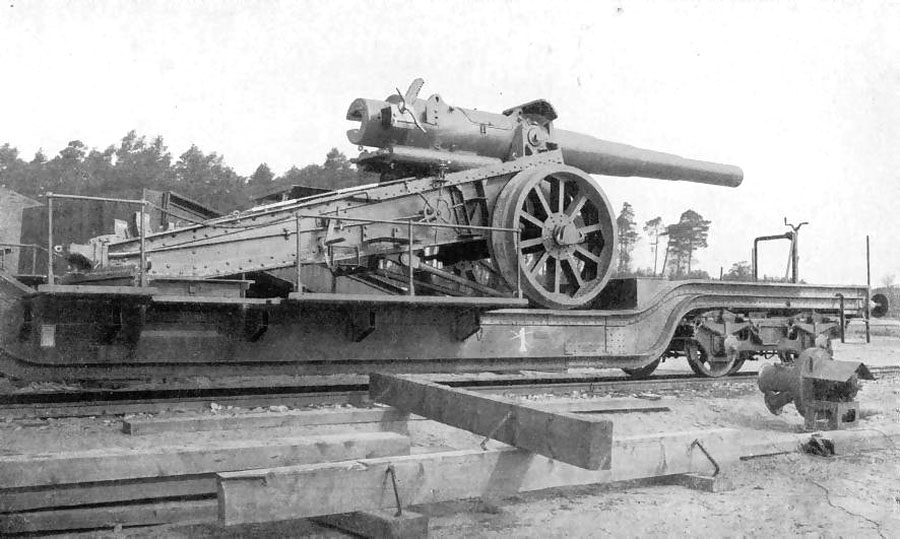 |
| Due to the problems of moving such a heavy cannon and emplacing it, the solution was to place the 17cm SK L/40 i.R. on railway flatbeds giving these cannons the designation 17cm SK E (Eisenbahngeschütze = railway gun). The 17cm SK E were soon named "Samuel" by their crews and it proved to be a highly effective weapon. It could be moved rapidly into position as required without need for constructing cumbersome emplacements. References state that 30 17cm SK L/40 were converted into the "E" variant.
|
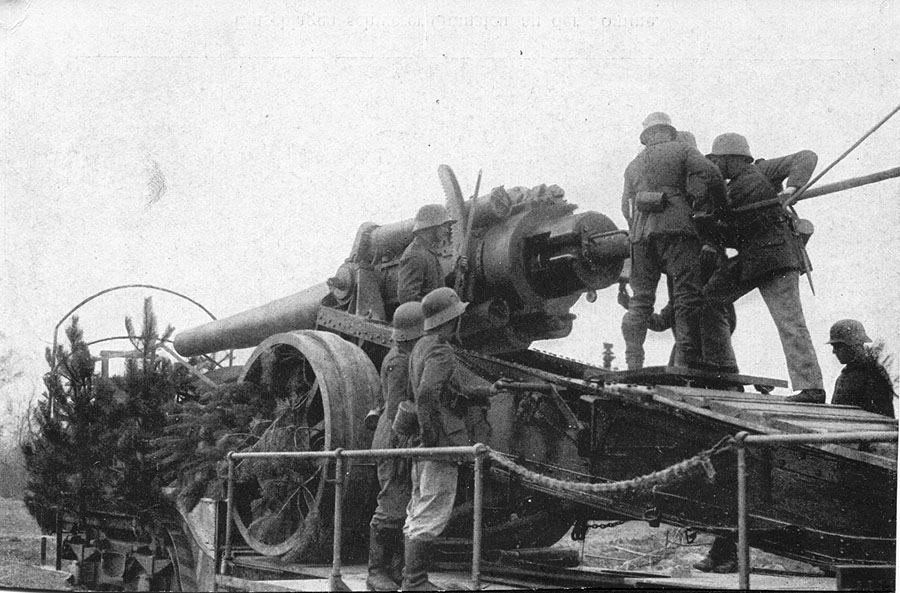 |
| In this photo the crew of a 17cm SK L/40 Samuel Eisenbahngeschütze load the 64 kg (141.0 lbs) Armour Piercing High Explosive projectile to be followed by the cartridge casing, |
| |
|
 |