| 7,7cm leichte Feld Kanone (l.F.K.) 96 n/A 1st Production Cartridge Casing | ||
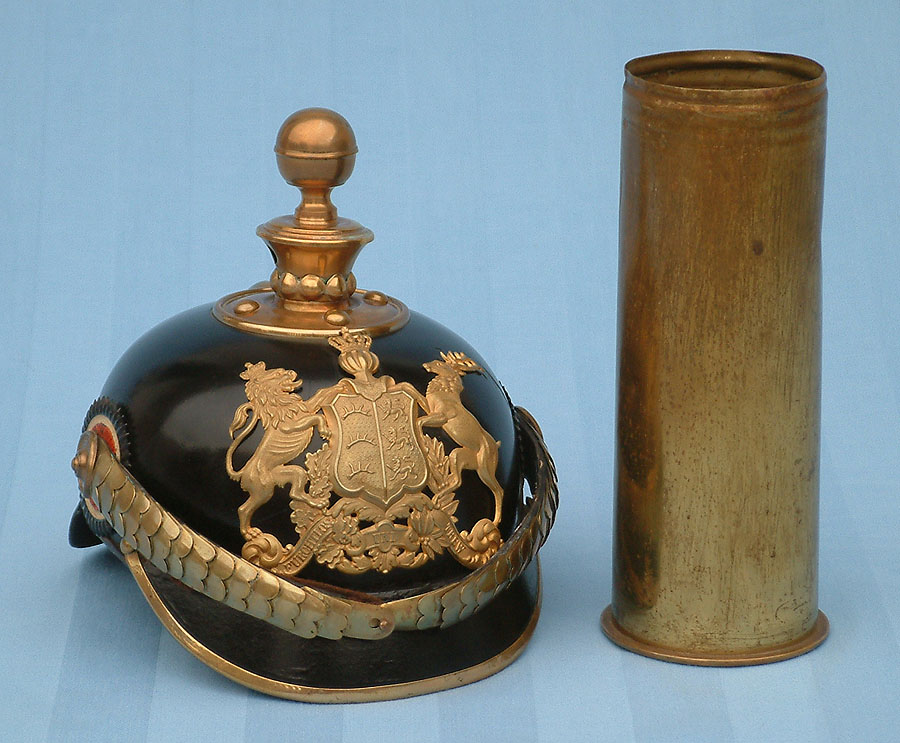 | ||
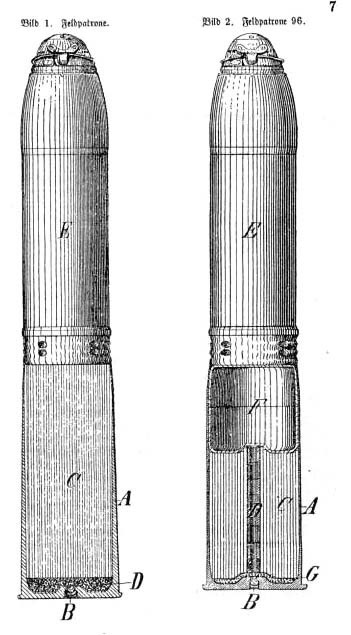
| 7,7cm 1st production cartridge casing for the Krupp leichte Feld Kanone (l.F.K. = light field cannon) 96 n/A (neuer Art = new model). One important difference for this "new model" was that the cartridge casing for the 7,7cm l.F.K. 96 n/A fixed ammunition was considerably longer at 227mm (8.93 inches) compared to 132mm (5.19 inches) for the 7,7cm l.F.K.96 a/A separate ammunition (projectile loaded then followed by the cartridge casing). The 1st production 7,7cm l.F.K. 96 n/A cartridge casings are paper thin and very light, resulting in a limited number of times it could be reloaded. They are very easily bent or dented making surviving 1st production 7,7cm l.F.K.96 cartridge casings quite scarce. To illustrate the size, the casing is photographed with an original Model 1894 Württembergisches Feld-Artillerie Mannschaften Eigetumsstück (privately purchased) Pickelhaube. 7,7cm leichte Feld Kanone (l.F.K.) 96 n/A 1st Production Cartridge Casing Data:
|
||
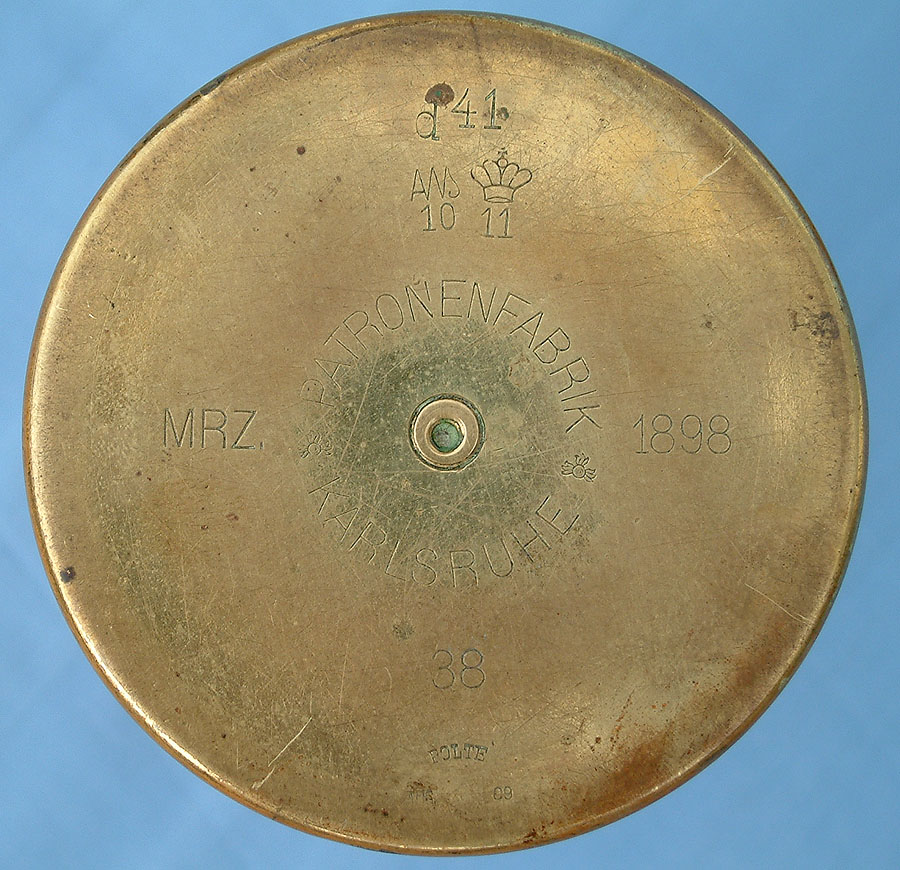 | ||
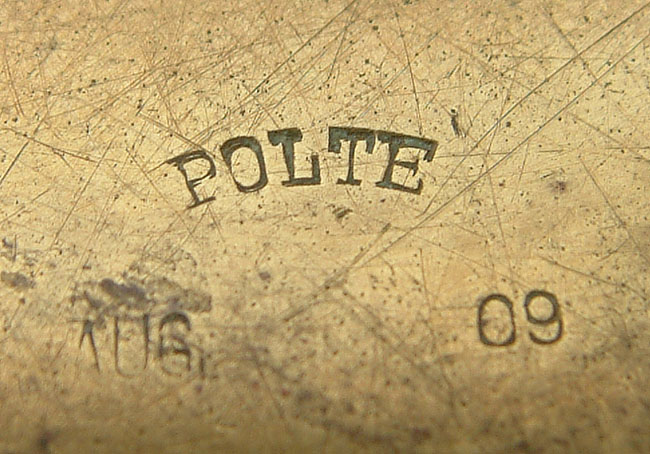
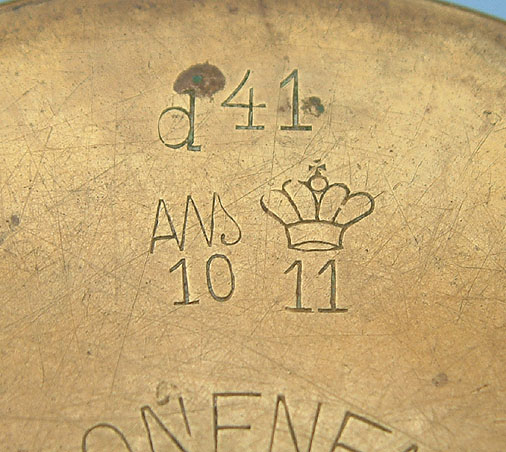
| A close-up of the amazing head stampings on the base. This cartridge casing is highly unusual, in that it is marked to no less than three different manufacturers making this example truly unique. The casing was initially manufactured by Patronenfabrik Karlsruhe but reloaded by two different manufacturers and subsequently stamped. As a result, there are three manufacturer stampings and three company inspection stamps. Around the primer it is marked: PATRONENFABRIK (cartridge factory) KARLSRUHE manufactured "MRZ. 1898" (March 1898) with the standard twin flaming bombs for this manufacturer. "38" is the lot number of that batch of cases which were made during 1898. At the bottom is a tiny stamped "Patronenfabrik Polte Magdeburg" indicating that at some point Polte reloaded this cartridge casing. At the top, is an "AWS" for Artillerie Werkstatt Spandau indicating that this company also reloaded this cartridge casing. | ||
| ||
| ||
| ||
| 7,7cm leichte Feld Kanone (l.F.K.) 96 n/A | ||
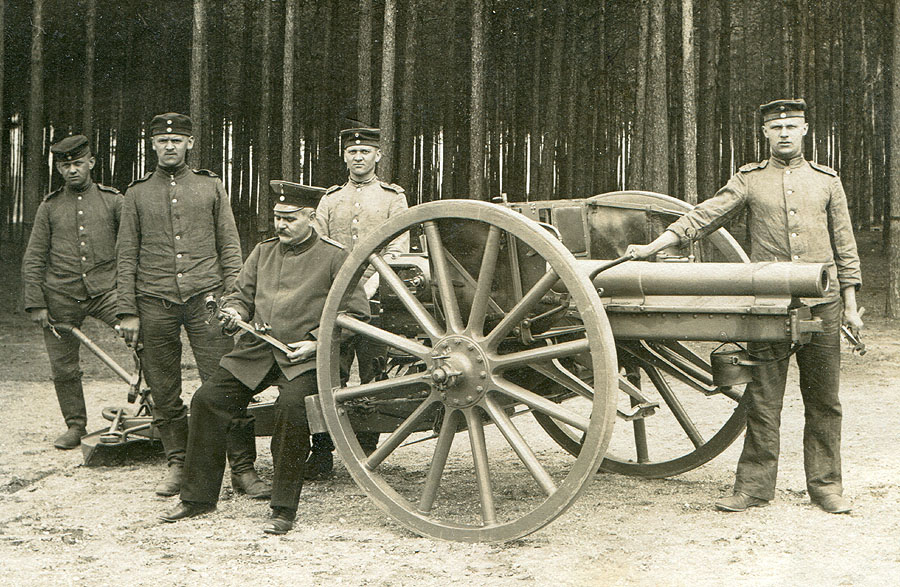 | ||
| The 7,7cm leichte Feld Kanone (l.F.K.) 96 n/A (neuer Art = new model) was a light field cannon adopted by the Feldartillerie (Field Artillery) in 1896. The German Feldartillerie had just fielded their new 7,7cm l.F.K. 96 when the French Army introduced their famous Canon de 75 modèle in 1897 which immediately rendered the newly fielded German 7,7cm l.F.K.96 obsolete. This led to an frantic re-arming of the German Feldartillerie to a modern field cannon, which although different in every respect (other than the calibre) from the 7,7cm l.F.K.96 was cleverly named the 7,7cm l.F.K. 96 n/A (neuer Art = new model) resulting in the 1st and now obsolete model to be called the 7,7cm l.F.K.96 a/A (alter Art = old model). The 7,7cm l.F.K.96 n/A was the 1st modern cannon for the Feldartillerie having a high rate of fire, significantly improved accuracy, improved range, a reliable recoil system, and crew protection with a shield. Two seats were provided on the axle for two Kanonier (Gunners). 7,7cm leichte Feld Kanone (l.F.K.) 96 n/A Data:
| ||
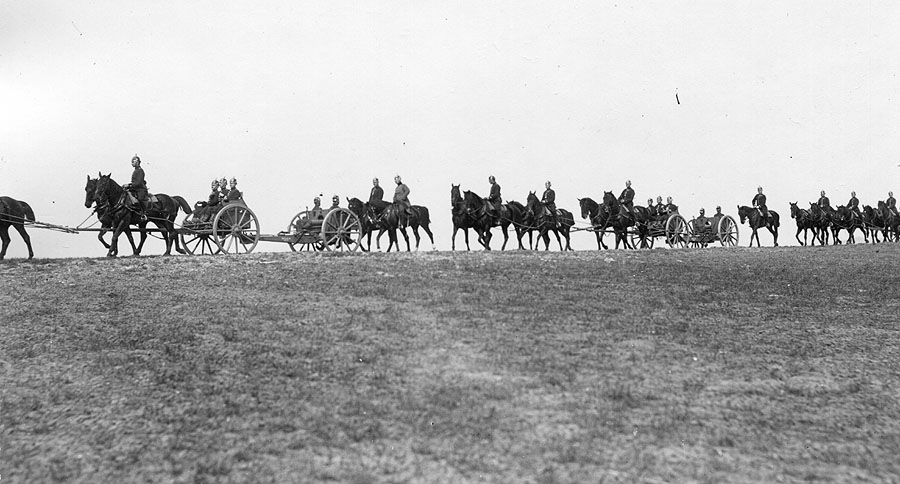 | ||
| In this series of photographs which appears to be a peacetime practice, a Batterie (battery) from 3. Württembergisches Feld-Artillerie-Regt. Nr.49 (Ulm) XIII Armee Korps moves to and occupies fire positions. This 1st photograph shows the Batterie on the march. Note that for every team of two horses there is one rider; six horses per cannon resulted in 3 riders. Three Kanonier (Gunners) sat on the ammunition limber (eating the horse's dust) while two more Kanonier sat facing rearward on the seats mounted to the axle of the 7,7cm l.F.K. 96 n/A. Officer's, NCOs, and Fire Control Observers rode their own mounts. | ||
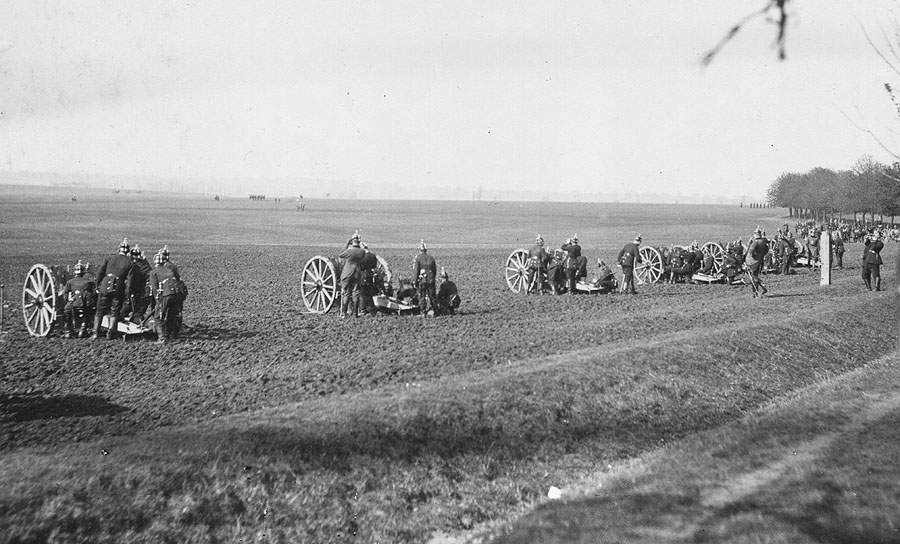 | ||
| Once at the fire position, the limbers were moved rearward of the cannons and the horses were all taken to low ground to the rear of the position for safety from fire. As with all Feldartillerie Regiments, 3. Württembergisches Feld-Artillerie-Regt. Nr.49 consisted of 2 Bataillon (battalions) which comprised of 3 Batterie (battery) per Bataillon. Each Batterie had 6 cannons. In this photograph at least nine 7,7cm l.F.K. 96 n/A are visible indicating at least two Batterie. | ||
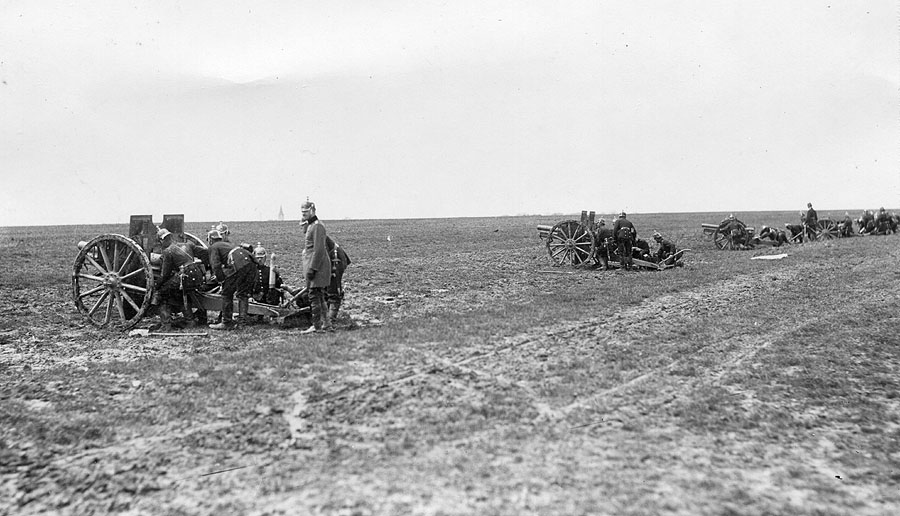 | ||
| At the fire position each 7,7cm l.F.K. 96 n/A was readied for action as quickly as possible with several wicker baskets each containing three 7,7cm fixed rounds. Note that the officer's are wearing the knee-length Überrock, which was the prescribed dress for officers in the field. Officer's only wore the Waffenrock on parade and other formal occasions. | ||
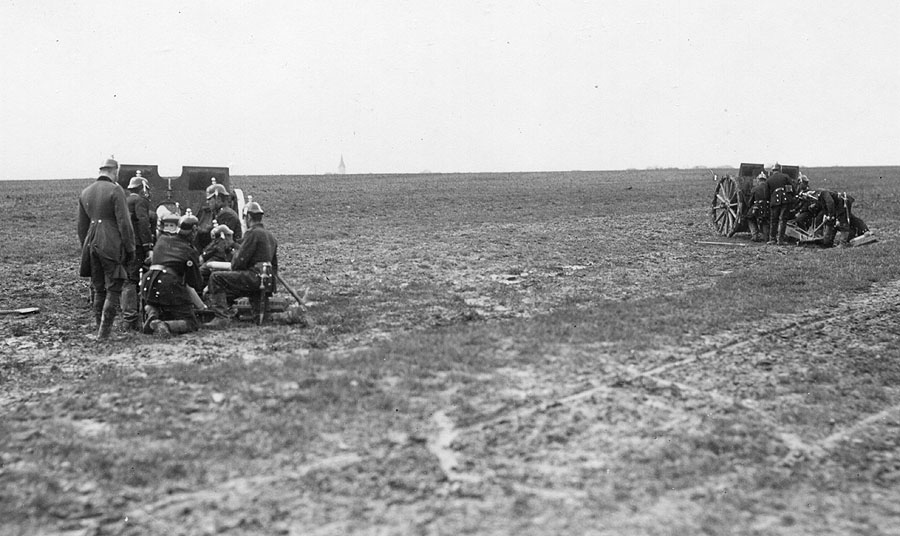 | ||
| As ammunition was expended, Kanonier not actively employed in the firing of the cannon were kept busy running back to the limbers to obtain more wicker baskets of the fixed 7,7cm ammunition. | ||
 |