| Model 1915 Preußen Officer's Pickelhaube |
| |
In 1915 a new Pickelhaube for Mannschaften (other Ranks) was introduced with a removable spike and a leather M91 leather chinstrap to replace the metal chinscales still being worn by some units such as cavalry and artillery.
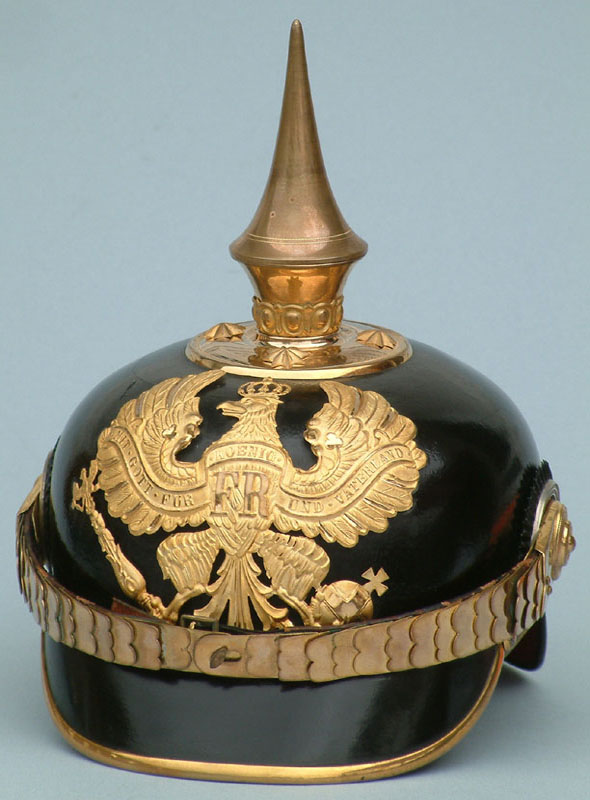
To prevent officer's from being easily spotted with their fixed spike tops and reflective chinscales, a new model of Pickelhaube specifically for officers was introduced in 1915 which also had a removable spike and metal chinscales. The quality of the helmet construction or finish was not affected as shown by this near-mint example of a Preußen Infantry officer's M15 Pickelhaube.
|  | |
 |
| |
| A view of the Preußen Line officer's eagle Wappen (front plate). This Wappen retains all the original mercury-gilding. The metal fittings on privately purchased Pickelhaube were initially mercury-gilded which results in a frosted appearance with little reflective surfaces. The spike, chinscales, and other fittings were then polished to a obtain a highly reflective appearance. As is typical for a high-quality Wappen, low areas on alternating feathers as well as some high areas such as the "FR" have been polished to add contrast to the gilding. To conserve brass, the Wappen stamping is paper-thin. It is so thin, that some areas like the right knee of the eagle show through.
|
| |
 | From the rear, the helmet appears to be a standard officer's example, it is only the three rivets on the chinscale that indictae this is actually a Model 1915. | |
 |
| |
The side profile, showing that this rather scarce pattern of M1915 officer's Pickelhaube is in remarkable condition.
Although it is common to find wartime officer helmets with a shell made from fiber, the skull of this example is made from leather.
|
| |
 | This photograph shows the Pickelhaube disassembled into the main components.
The spike and chinscales are removed as are the special officer's Kokarden which are designed to fit around the M1891 chinstrap post.
| |
A close-up of the removable spike. Note that virtually all the polished gilding remains intact. The spike is secured to the spike base with a slotted bayonet fitting similar to the Mannschaften M1915 spike top.
The bayonet fitting is oxidized grey, as this part protruded through the top of the Überzug (helmet cover) when the spike was not worn.
|  | |
 | A close-up of the removable chinscales. Like the other fittings, all the polished gilding remains intact.
On previous officer Pickelhaubes, the chinscales were held onto the shell with split-brad rosettes. On the M1915 officer Pickelhaube, the rosettes are faux (false) and pressed into the first scale, as behind the faux rosette is a M1891 chinstrap mount. To keep the chinscales on the leather backing there are three rivets, a feature not found on previous officer models. In period photographs, these three rivets are the only way to visually identify an officer's Pickelhaube as being an M1915. | |
When the chinscales are removed, a standard Model 1891 chinstrap post is revealed. In the field, the chinscales were removed and a standard M1891 leather chinstrap was worn.
This photo shows why the rosettes are pressed into the first scale, as where the rosette would normally be, there is a hole to accomodate the M1891 chinstrap mount.
|  | |
 | The helmet liner is the officer pattern with a high quality calf-skin sweatband coupled by a silk skull cap.
The liner shows some very slight wear, indicating that this example was worn.
| |
| The removable spike and chinscales necessitated a new model of Überzug for officers which had a removable cloth spike top for when the spike was not worn. When the chinscales were removed, the M91 leather chinstrap was mounted and inserted through circular sewn slits on the side of the Überzug.
|  | |
 | As this photo shows, the protruding bayonet fitting is oxidized grey as this part protruded through the top of the Überzug when the spike was not worn. | |
 |
| A rare grouping; the matching Model 1915 Preußen officer's Model 1915 Pickelhaube and Überzug, Model 1915 Overcoat, and Model 1915 Schirmmütze. To see the Schirmmütze click Here. To see the Overcoat click Here. |
| |
|
| |
 |